
Quick Answer & Key Takeaways
Tapered roller bearings engineered for Tunnel Boring Machine (TBM) cutterheads provide critical radial and axial load support under severe underground shock loads, high torque, and abrasive slurry conditions. In modern shield tunneling, cutterhead bearings must withstand simultaneous thrust forces exceeding tens of thousands of kilonewtons while maintaining strict rotational alignment. Designed with steep contact angles, case-hardened alloy steels, and advanced multi-lip sealing systems, these bearings prevent premature micro-spalling, raceway cracking, and lubricant contamination. TBM mechanical engineers and procurement teams select high-capacity tapered roller bearings to prevent catastrophic subterranean cutterhead failure, extend maintenance intervals during long-drive tunneling, and lower overall total cost of ownership.
-
Combined Load Management: Conical geometry simultaneously handles extreme radial pressures and massive axial thrust generated by cutter disc rock penetration.
-
Impact & Fatigue Resistance: Case-carburized bearing steels absorb dynamic shock loads from non-homogeneous rock faces without brittle raceway cracking.
-
Contamination Defense: Multi-stage labyrinth and lip seals keep groundwater, bentonite slurry, and abrasive rock dust out of critical raceway zones.
-
Predictable Service Life: Crowned roller profiles eliminate edge-loading stress concentration, ensuring extended operating life through demanding tunnel lengths.
What Are TBM Cutterhead Tapered Roller Bearings and How Do They Work?
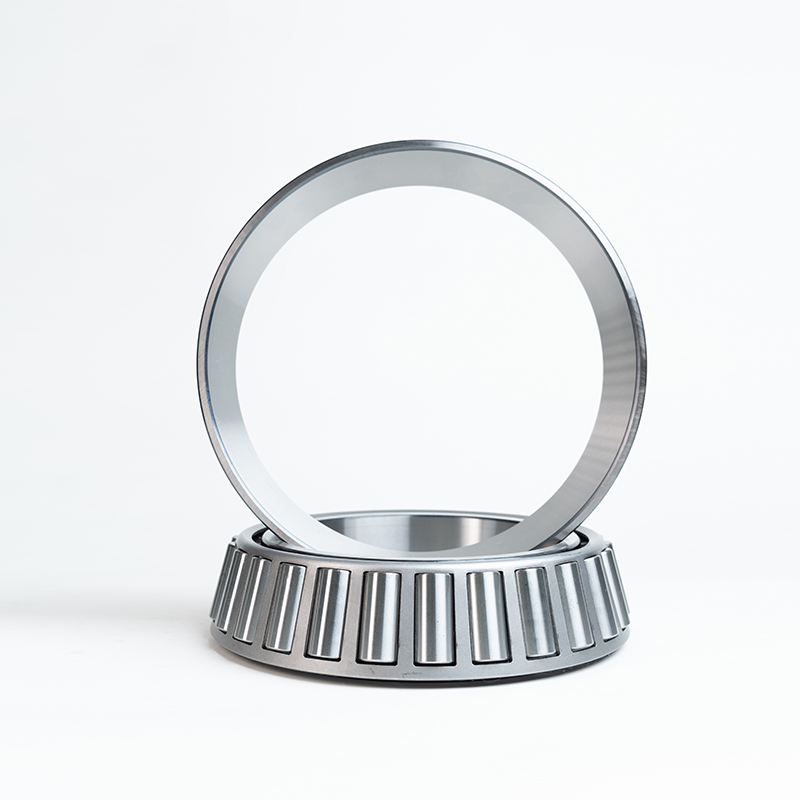
Tapered roller bearings for TBM cutterheads are heavy-duty, high-precision rolling-element bearings designed specifically to transmit driving torque and absorb crushing thrust forces during mechanical tunneling. Featuring conical rollers guided by a high inner ring rib running between tapered inner and outer raceways, these components operate on the principle of converging contact lines.
The underlying mechanism allows the bearing to resolve complex multi-axis load vectors into clean normal forces perpendicular to the raceway angle. As the TBM cutterhead presses against solid rock, the steep taper angle redirects heavy forward thrust into the housing structure, maintaining precise alignment for primary drive pinions and hydraulic motors even during erratic cutterhead vibrations. Crowned roller profiles spread contact stresses evenly across the full raceway length, preventing edge fatigue.
Critical Performance Demands in Underground Excavation
Subterranean shield tunneling presents some of the most aggressive working environments in heavy mechanical engineering:
-
Handling Extreme Combined Loads: Hard rock tunneling requires thousands of metric tons of forward thrust alongside heavy radial gravity loads from the rotating cutterhead weight. Tapered roller bearings resolve these multi-directional forces efficiently through their angled roller contact path.
-
Withstanding Dynamic Impact and Vibration: Transiting through mixed-face geology—such as alternating soft clay and hard granite—causes severe dynamic shock loads. Case-hardened core microstructures allow the bearing to flex elastically without catastrophic ring fracture.
-
Blocking High-Pressure Slurry Ingress: Earth Pressure Balance (EPB) and Slurry TBMs operate under hydrostatic pressures reaching 5 to 10 bar. Bearings must integrate with specialized sealing systems to prevent abrasive rock flour and water from diluting heavy gear oils.
-
Extended Life Without In-Tunnel Replacement: Replacing a main drive or cutter disc bearing inside a narrow tunnel shield requires months of downtime and millions in losses. Bearings must achieve reliable L10h service life ratings exceeding 10,000 to 20,000 hours of continuous operation.
Selecting drive and cutterhead bearings involves matching rolling element geometry to specific geological stress regimes and operational priorities across combined load efficiency, structural rigidity, shock resistance, and thermal control.
In combined load efficiency, single or double-row tapered roller bearings offer superior axial thrust capability compared to standard cylindrical roller bearings. While cylindrical designs offer high radial capacity, their flat geometry cannot absorb heavy primary axial thrust without relying on friction-heavy rib contacts.
Regarding structural rigidity under moment loads, preloaded tapered roller bearing pairs create a wide effective spread distance. This high angular stiffness limits cutterhead tilt and deflection far more effectively than spherical roller bearings, which tend to yield slightly under high tilting moments.
In terms of shock load tolerance, case-carburized tapered roller bearings outperform through-hardened alternatives. The ductile inner core of case-hardened steel cushions severe rock impacts, whereas through-hardened bearing steels risk subsurface fatigue cracking under recurring dynamic stress.
Finally, thermal management under heavy load differs across designs. Tapered roller bearings require precise initial setting or preloading to manage frictional heat generation. However, when paired with circulating oil cooling systems, their controlled contact kinematics maintain stable operating temperatures during high-rpm soft-ground tunneling.
Key Industrial Applications in Tunneling Equipment
Tapered roller bearings serve as crucial load-bearing anchors across multiple assemblies within mechanical shield machines:
1. TBM Main Drive Support Assemblies
Large-diameter tapered roller bearing arrangements directly support the main cutterhead drive gear, transmitting main thrust cylinder forces to the shield body.
2. Disc Cutter Hub Assemblies
Individual 17-inch and 19-inch rock disk cutters rely on heavy-duty imperial or metric single-row tapered roller bearings to handle continuous rock crush impacts at the tunnel face.
3. Pipe Jacking and Microtunneling Cutterheads
Compact utility tunneling machines use paired tapered roller bearings to sustain high thrust pressures in tight underground envelopes.
4. Heavy-Duty Shield Driving Gearboxes
Multi-stage planetary reduction gearboxes driving the cutterhead use tapered roller bearings on high-torque output shafts to maintain gear mesh alignment.
Engineering Selection and Maintenance Guide for Procurement Teams
Procurement managers and mechanical engineers specifying cutterhead bearings should evaluate four essential technical factors:
-
Verify Steel Cleanliness and Heat Treatment: Ensure bearings are forged from vacuum-degassed alloy steels with case-carburizing heat treatment to withstand shock-induced subsurface shear stress.
-
Calculate Equivalent Dynamic Load and L10h Life: Account for peak impact factors (typically 1.5 to 2.0 times static thrust) when calculating expected bearing operating life across variable geological zones.
-
Inspect Seal Compatibility and Grease Channels: Confirm that outer rings incorporate dedicated re-lubrication grooves and integrate seamlessly with multi-lip cassette seals and pressure-compensated grease barriers.
-
Enforce Precise Clearance and Preload Setting: Utilize precision shimming or hydraulic nut drive-up methods during assembly to achieve optimal operational preload, preventing roller skidding or overheating.
Frequently Asked Questions (FAQ)
Why are tapered roller bearings preferred over cylindrical bearings for TBM cutterheads?
Tapered roller bearings naturally handle high combined radial and axial thrust loads due to their angled raceway geometry. Cylindrical roller bearings excel primarily at radial loads and cannot sustain the continuous multi-ton axial forward thrust produced by TBM drive cylinders.
How do case-hardened steels protect TBM bearings from shock loading?
Case-hardened (case-carburized) steel creates a hard, wear-resistant outer raceway layer supported by a tough, ductile inner core. When dynamic shock loads hit the cutterhead during rock fracturing, the ductile core absorbs the shock energy without brittle cracking.
What causes cutterhead bearing failure in subterranean environments?
The leading causes of cutterhead bearing failure are lubricant contamination from water and slurry ingress, excessive edge-loading due to shaft deflection, and subsurface fatigue spalling caused by prolonged unmitigated shock loads.
Can imperial and metric tapered roller bearings be interchanged in TBM disc cutters?
Interchangeability depends entirely on housing dimensions and shaft tolerances. While both imperial and metric designs offer equivalent load capacities, envelope dimensions, cone angles, and mounting clearances must match original equipment manufacturer (OEM) specifications exactly.
How is lubrication maintained in TBM main drive bearings under high pressure?
TBM main drive bearings utilize continuous circulating oil systems equipped with heat exchangers, fine particle filtration, and positive pressure grease barriers. The positive pressure keeps bentonite slurry and groundwater from bypassing the outer lip seals into the bearing cavity.
Post time: Sep-17-2026