
Quick Answer & Key Takeaways
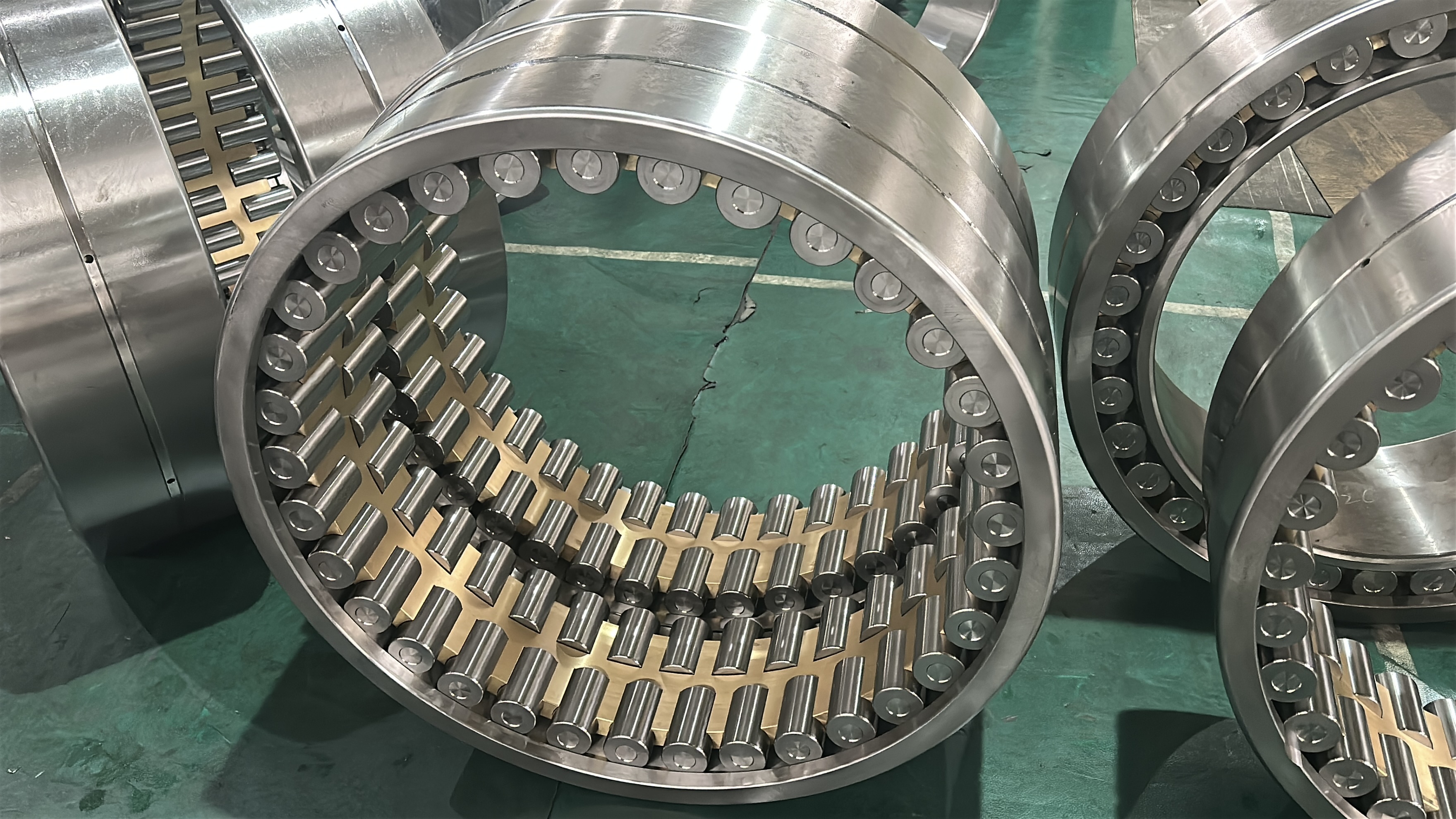
Four-row cylindrical roller bearings engineered for steel rolling mills deliver maximum radial load capacity, minimal frictional torque, and precise dimensional control in heavy-duty metal forming applications. Steel mill roll necks undergo extreme multi-ton radial forces, intense thermal shocks, and continuous cooling water exposure during hot and cold rolling operations. Featuring four rows of high-precision cylindrical rollers guided by precision cages, these bearings maximize raceway contact area within a compact envelope, allowing mill operators to increase roll neck diameters and overall shaft rigidity. Industrial procurement teams and rolling mill engineers implement four-row cylindrical roller bearings to minimize boundary wear, prevent roll neck necking, extend maintenance intervals, and reduce costly unscheduled mill downtime in modern steel manufacturing facilities.
-
Maximum Radial Load Capacity: Four-row roller configuration distributes extreme radial rolling loads evenly across four parallel raceway contact zones.
-
Separable Design for Easy Mounting: Independent inner rings, outer rings, and roller-cage assemblies simplify roll changeovers and inspection procedures.
-
High Rotational Speed Capability: Pure rolling line contact and low internal friction support elevated linear strip speeds in modern cold tandem mills.
-
Enhanced Roll Neck Rigidity: Compact radial cross-section allows larger roll neck diameters, reducing shaft deflection and improving metal sheet gauge tolerance.
What Are Four-Row Cylindrical Roller Bearings and How Do They Work?
Four-row cylindrical roller bearings are heavy-duty precision rolling-element bearings designed specifically to support roll necks in steel mill work rolls, intermediate rolls, and back-up rolls. Built with four parallel rows of precision-ground cylindrical rollers housed within double-outer and inner ring assemblies, these bearings offer the highest radial load rating per unit cross-sectional area of any rolling bearing design.
The core operating principle relies on pure radial line contact across all four roller rows. Because cylindrical rollers do not sustain axial thrust loads natively, four-row cylindrical roller bearings are traditionally paired with auxiliary thrust bearings—such as double-row tapered roller bearings or deep groove ball bearings—to handle axial positioning. This separation of radial and axial load vectors ensures that the heavy radial compression forces from hydraulic mill screwdowns are borne exclusively by the four cylindrical roller rows without inducing destructive skewing moments.
Critical Performance Demands in Steel Rolling Mill Operations
Steel production environments present severe mechanical and environmental stresses that directly test bearing structural limits:
-
Absorbing Extreme Radial Compression Forces: Hot strip mills and plate mills apply thousands of metric tons of separation force to reduce steel slabs. Four-row cylindrical roller bearings spread these immense compression stresses over four full roller rows, preventing premature sub-surface fatigue spalling.
-
Sustaining Thermal Spikes and High Speeds: Hot rolling exposes roll neck bearings to radiant heat from red-hot slabs alongside high rotational speeds during finishing passes. Premium vacuum-degassed bearing steel with heat-stabilization treatment prevents dimensional changes at continuous temperatures exceeding 150°C to 200°C.
-
Resisting Water and Mill Scale Contamination: High-pressure descaling water and abrasive iron oxide scale constantly flood roll neck chocks. Advanced four-row bearings utilize specialized labyrinth chock seals and water-resistant extreme pressure (EP) greases or oil-air lubrication systems to prevent lubricant emulsification.
-
Facilitating Fast Roll Changes: Steel mills change worn rolls frequently to maintain product surface quality. The separable construction of four-row cylindrical bearings allows easy sliding mounting and dismounting of inner rings directly on roll necks without damaging precision raceways.
Comparative Performance Analysis: Four-Row Cylindrical vs. Alternative Roll Neck Bearings
Evaluating roll neck bearing configurations requires balancing radial load capability, speed thresholds, mounting convenience, and axial control across competing design methodologies.
In radial load density and roll neck rigidity, four-row cylindrical roller bearings outperform spherical roller bearings and four-row tapered roller bearings. Because four-row cylindrical rollers have a smaller radial section height, engineers can design thicker, stiffer roll necks within the same chock housing bore, significantly reducing roll deflection under full load.
Regarding speed capability and operating friction, four-row cylindrical roller bearings offer superior performance over four-row tapered roller bearings. The pure cylindrical contact generates significantly less friction and heat at high linear strip speeds, making cylindrical designs the standard choice for high-speed cold rolling tandem mills and rod mills exceeding 20 meters per second.
In terms of load vector separation, four-row cylindrical roller bearings absorb pure radial forces, requiring an auxiliary bearing for axial guidance. Conversely, four-row tapered roller bearings manage simultaneous radial and thrust loads in a single unit. However, combining both load types in tapered rollers can lead to unequal load distribution across the four rows during dynamic thermal expansion of the roll.
Finally, mounting and maintenance flexibility favors four-row cylindrical bearings. The inner rings can be heat-fitted semi-permanently onto roll necks while the outer ring and roller assemblies remain inside the chock. This separable setup permits rapid roll changes and allows inner rings to be ground alongside the roll neck on roll grinding machines to eliminate radial runout.
Key Industrial Applications in Steel Manufacturing Machinery
Four-row cylindrical roller bearings serve as the primary radial load support across various rolling mill stands:
1. Hot Strip Mill Work Rolls and Back-Up Rolls
Roughing and finishing stands in hot strip mills rely on four-row cylindrical roller bearings to support massive work roll necks, handling dynamic impact loads as steel slabs enter roll gaps at high temperatures.
2. Cold Tandem Mill Roll Necks
Cold rolling requires precise gauge control and high strip tension at elevated speeds. Four-row cylindrical roller bearings provide the sub-micron runout accuracy and low thermal generation required to maintain uniform sheet thickness.
3. Heavy Plate Mill Back-Up Roll Chocks
Plate mills subject rolls to extreme peak radial loads during initial breakdown passes. Four-row cylindrical roller bearings deliver the static and dynamic load capacity needed to process heavy steel plates without raceway deformation.
4. Wire, Rod, and Bar Section Mills
High-speed wire rod mills utilize four-row cylindrical roller bearings on intermediate and finishing stands to maintain precise pass-line alignment and long component life under continuous multi-shift production.
Engineering Selection and Maintenance Guide for Procurement Teams
Procurement managers and plant maintenance engineers specifying four-row cylindrical roller bearings should incorporate four essential technical practices:
-
Specify Premium Clean Bearing Steel: Ensure bearings are manufactured from high-purity, vacuum-degassed alloy steel or carburized case-hardened steel to withstand high-impact shear stresses and resist subsurface fatigue.
-
Match Radial Internal Clearance (RIC) to Operating Conditions: Select C3 or C4 radial clearance classes to accommodate thermal expansion differentials between inner rings heated by roll necks and outer rings cooled by chock housing jackets.
-
Optimize Roll Neck Inner Ring Grinding: Ensure inner ring raceways are ground after mounting onto the roll neck using specialized roll grinding equipment to achieve zero runout and precise wall thickness uniformity.
-
Implement Advanced Oil-Air Lubrication Systems: Replace traditional grease lubrication with continuous oil-air lubrication systems where applicable to maintain positive chock pressure, cool raceways, and constantly purge water and scale ingress.
Frequently Asked Questions (FAQ)
Why are four-row cylindrical roller bearings widely preferred for steel mill roll necks?
Four-row cylindrical roller bearings provide maximum radial load capacity within a minimal cross-sectional envelope. This allows mill designers to maximize roll neck diameter and rigidity, reducing roll deflection while supporting heavy compression forces and high rolling speeds.
How do four-row cylindrical roller bearings handle axial thrust loads?
Four-row cylindrical roller bearings are designed to absorb pure radial loads only. To manage axial thrust generated by mill side-guides or angled passes, they are paired with auxiliary thrust bearings, such as double-row tapered roller bearings or deep groove ball bearings mounted in the same chock.
Can four-row cylindrical roller bearing inner rings be ground together with the roll neck?
Yes, inner rings can and should be finish-ground together with the roll neck on a roll grinding machine. This practice eliminates mounting eccentricities, minimizes radial runout, and guarantees uniform roll gap control during thin-gauge sheet rolling.
What is the difference between case-hardened and through-hardened steel in roll neck bearings?
Case-hardened (carburized) steel features a hard, wear-resistant outer raceway paired with a tough, flexible inner core that absorbs dynamic shock loads without ring fracture. Through-hardened steel offers uniform hardness throughout, delivering excellent performance under steady high-stress loads but lower impact damping.
How does water contamination impact four-row cylindrical roller bearing life?
Cooling water emulsifies bearing grease, causing lubricant film breakdown, metallic contact, surface pitting, and rapid corrosion. Using specialized multi-lip chock seals, water-resistant greases, or continuous positive-pressure oil-air lubrication prevents water from entering the raceway cavity.
Post time: Sep-17-2026