
Spherical roller bearings are unique among rolling element bearings for their ability to accommodate both heavy radial and axial loads while compensating for shaft misalignment and deflection. Their barrel-shaped rollers run on a spherical outer raceway, allowing the bearing to self-align as shafts bend or housings shift during operation. This capability makes them indispensable in applications where rigid bearings fail prematurely: mining conveyors, steel mills, cement processing, paper machines, and wind turbines. For procurement and engineering teams, the bearing selection decision centers on matching internal clearance, cage design, and sealing configuration to specific operating conditions—misalignment tolerance, load magnitude, temperature range, and contamination exposure.
Key Takeaways:
- Spherical roller bearings self-align to accommodate angular misalignment typically up to ±1° without performance loss
- They support combined radial and axial loads in a single bearing arrangement, reducing design complexity
- Internal clearance selection (C2 through C5) must match operating temperature and interference fit requirements
- Modern high-capacity designs increase roller count through optimized internal geometry, raising load ratings without increasing bearing envelope
What Defines a Spherical Roller Bearing?
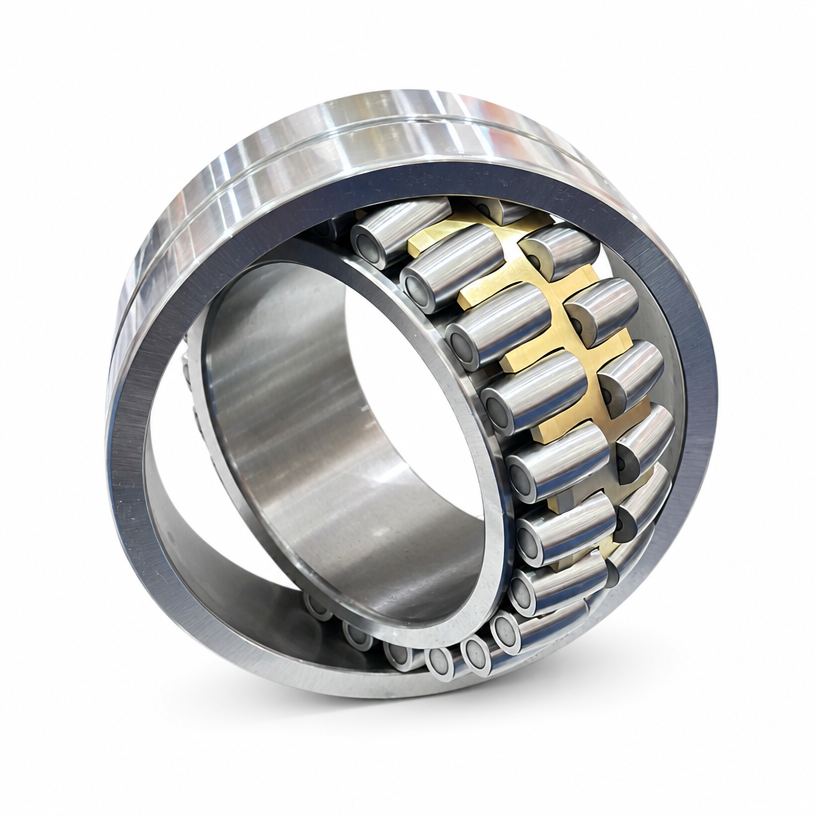
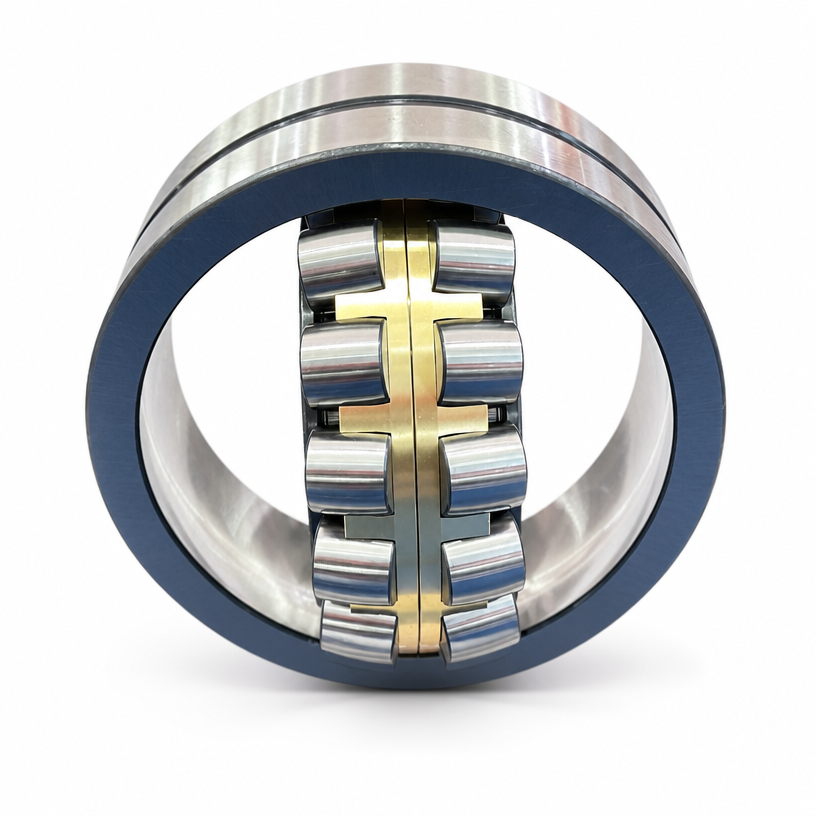
A spherical roller bearing is a rolling element bearing with barrel-shaped rollers arranged between an inner ring with two raceways and an outer ring with a common spherical raceway. This spherical outer raceway is the defining design feature: it allows the bearing to accommodate angular misalignment between the shaft and housing—whether from shaft deflection under load, installation tolerances, or housing deformation—without inducing additional internal stress.
Self-Alignment Capability: The Defining Advantage
The spherical outer raceway enables the bearing to accommodate angular misalignment between the inner and outer rings—typically up to ±1° in standard designs. This tolerance is critical in applications where long shafts deflect under load, where multiple bearing supports create alignment challenges, or where thermal expansion causes relative movement between components.
In practice, this self-alignment capability translates directly to reliability. Where cylindrical or tapered roller bearings require precise alignment and fail when operating conditions deviate, spherical roller bearings continue to perform. This makes them the preferred choice for:
- Long conveyor systems where shaft deflection is unavoidable
- Steel mill equipment subject to thermal expansion
- Vibrating screens and crushers with shock loading
- Wind turbine main shafts where alignment changes over time
Load Carrying Characteristics
Spherical roller bearings are engineered to support combined radial and axial loads in a single bearing arrangement. This eliminates the need for complex bearing configurations involving separate radial and thrust bearings.
Internal Clearance Selection: Critical to Service Life
Internal radial clearance—the total clearance inside the bearing in the radial direction—is one of the most important selection parameters for spherical roller bearings. The clearance group designation (C2, CN, C3, C4, C5) determines the initial clearance before mounting and is specified by suffix codes on the bearing designation.
Clearance Selection Criteria
Standard (CN) clearance is suitable for normal operating conditions with moderate temperature differentials and light interference fits. However, for many industrial applications:
- C3 clearance is the most commonly specified and stocked option. It accommodates the thermal expansion and interference fit conditions typical of heavy industrial applications.
- C4 clearance is required where both a heavy shaft fit and high operating speeds generate significant heat.
- C2 clearance (reduced clearance) may be specified where operating temperatures are stable and minimal thermal expansion is expected.
For tapered bore bearings mounted on adapter sleeves or tapered shafts, clearance reduction during mounting is the primary method for achieving proper interference fit. The mounting procedure involves:
1. Measuring the initial radial internal clearance
2. Driving the bearing onto the taper incrementally
3. Checking clearance reduction at each step
4. Stopping when the specified clearance reduction is achieved
This is particularly critical for large bearings where alternative methods (such as measuring inner ring expansion or lock nut tightening angle) may be less practical.
Temperature and Heat Treatment Considerations
Spherical roller bearings are available with steel stabilization for operating temperatures up to 200°C. This high-temperature capability is essential for applications such as paper machine dryer sections, where steam temperatures typically reach approximately 180°C.
However, thermal management requires careful consideration beyond just the bearing’s rated temperature. In paper machine dryer sections, differential thermal expansion between the journal and bearing inner ring can create hoop stress—circumferential stress that can lead to inner ring fracture over time. During startup, the journal heats faster than the bearing inner ring, creating a tight interference fit that imposes continuous stress on the inner ring.
Application-Specific Solutions
For high-temperature applications with thermal cycling, advanced heat-treated bearings with carbonitriding or case-hardened structures provide increased resistance to hoop stress and fracture. These specialized bearings may offer up to 2x the hoop stress strength of standard through-hardened bearings.
In paper machines, standard spherical roller bearings remain appropriate for less thermally demanding sections, while application-specific bearing designs are recommended for dryer and calender sections where thermal stress is most severe.
Industry Applications
Mining and Material Handling: Conveyors, crushers, vibrating screens. Self-alignment accommodates shaft deflection; sealed variants protect against abrasive dust.
Steel Production: Continuous casters, cooling beds, rolling mills. High-temperature capability and shock load tolerance are essential.
Cement Processing: Kilns, mills, crushers. Dust contamination and vibration environments demand robust sealing and internal clearance management.
Paper Machines: Dryer sections, calender rolls, canvas rolls. High temperatures and thermal cycling require advanced heat-treated bearing designs.
Wind Turbines: Main shafts, gearboxes. X-life premium bearings are predominantly used for rotor bearing arrangements due to improved macrogeometry and microgeometry.
Frequently Asked Questions
What is the primary advantage of spherical roller bearings over other roller bearing types?
Their self-alignment capability. Spherical roller bearings accommodate shaft deflection and housing misalignment that would cause premature failure in cylindrical or tapered roller bearings.
How do I select the correct internal clearance for a spherical roller bearing?
C3 clearance is the most commonly specified option for industrial applications. Select C4 for high speeds with heavy shaft fits, and C2 or CN for stable temperature conditions with minimal expansion.
Can spherical roller bearings support pure axial (thrust) loads?
Generally not recommended. Spherical roller bearings require some radial load to function properly. For pure thrust applications, consult the manufacturer’s application engineering team.
What temperature range can spherical roller bearings handle?
Standard spherical roller bearings are stabilized for operating temperatures up to 200°C. Sealed bearings with NBR seals are limited to 100°C; FKM seals extend to 200°C.
What is the maximum misalignment that spherical roller bearings can accommodate?
Standard designs typically allow a maximum of ±1° of static and dynamic misalignment. Consult manufacturer documentation for specific bearing series.
replenishment.
## Industry Applications
**Mining and Material Handling**: Conveyors, crushers, vibrating screens. Self-alignment accommodates shaft deflection; sealed variants protect against abrasive dust.
**Steel Production**: Continuous casters, cooling beds, rolling mills. High-temperature capability and shock load tolerance are essential.
**Cement Processing**: Kilns, mills, crushers. Dust contamination and vibration environments demand robust sealing and internal clearance management.
**Paper Machines**: Dryer sections, calender rolls, canvas rolls. High temperatures and thermal cycling require advanced heat-treated bearing designs.
**Wind Turbines**: Main shafts, gearboxes. X-life premium bearings are predominantly used for rotor bearing arrangements due to improved macrogeometry and microgeometry.
## Frequently Asked Questions
**What is the primary advantage of spherical roller bearings over other roller bearing types?**Their self-alignment capability. Spherical roller bearings accommodate shaft deflection and housing misalignment that would cause premature failure in cylindrical or tapered roller bearings.
**How do I select the correct internal clearance for a spherical roller bearing?**C3 clearance is the most commonly specified option for industrial applications. Select C4 for high speeds with heavy shaft fits, and C2 or CN for stable temperature conditions with minimal expansion.
**Can spherical roller bearings support pure axial (thrust) loads?**Generally not recommended. Spherical roller bearings require some radial load to function properly. For pure thrust applications, consult the manufacturer’s application engineering team.
**What temperature range can spherical roller bearings handle?**Standard spherical roller bearings are stabilized for operating temperatures up to 200°C. Sealed bearings with NBR seals are limited to 100°C; FKM seals extend to 200°C.
**What is the maximum misalignment that spherical roller bearings can accommodate?**Standard designs typically allow a maximum of ±1° of static and dynamic misalignment. Consult manufacturer documentation for specific bearing series.
Post time: Aug-24-2026